 OwnTime
ADHD Executive Function: Build a Deep-Work Launchpad
Why deep work fails before the first distraction
For founders and freelancers with ADHD, a deep-work block often collapses before the work even begins because opening the laptop can mean choosing a priority, finding the right file, defining the task, estimating the time, and deciding what to ignore. That is a heavy startup load.
Executive function covers the practical skills behind keeping a goal in mind, starting, shifting attention, planning, and resisting a tempting detour when the payoff is faster. It is not a character score.
Research on adult ADHD looks at basic functions such as distractibility and processing speed alongside planning, working memory, and cognitive flexibility; one study found that accounting for basic functions substantially reduced the apparent contribution of complex-function impairments to ADHD diagnosis (PLOS One). Start with distraction and friction.
This is a work setup, not medical advice or a replacement for ADHD assessment and treatment.
Motivation is rarely the missing tool
Myth: “If the project mattered enough, I would naturally start.”
Reality: Important work can be harder to start when it is vague, emotionally loaded, or big enough to conceal several decisions. Higher stakes add pressure.
Myth: “A perfect schedule will force focus.”
Reality: A calendar can protect an hour, yet it cannot turn a foggy assignment into an actionable next step or supply energy that is not available. It is a container.
Myth: “A short timer works for everyone with ADHD.”
Reality: Timers can provide a useful boundary, though a rigid 25-minute interruption is irritating when useful momentum has finally arrived. Use a timer if it helps.
Most elaborate focus systems are polished busywork until they answer one plain question: what happens when it is time to begin? “Review the dashboard and prioritize” merely moves the hard part to a prettier screen.
Choose one observable finish line
Do not open a focus session with a category such as marketing, taxes, client work, or life admin, because categories invite wandering and give progress nowhere to land. Pick one visible outcome instead.
Bad: Work on the proposal.
Better: Draft the problem-and-scope section for Acme’s proposal.
Best: Write four scope options in the proposal document and send the draft to Sam for review.
A finish line can be substantial, provided another person could tell whether it happened without interpreting your intentions. Clarity wins here.
When the outcome still feels sticky, define a five-minute entry action such as opening the document, writing four headings, pulling up the contract, or listing the client questions that need answers. Getting started is often the work.
Build a launchpad before the focus window
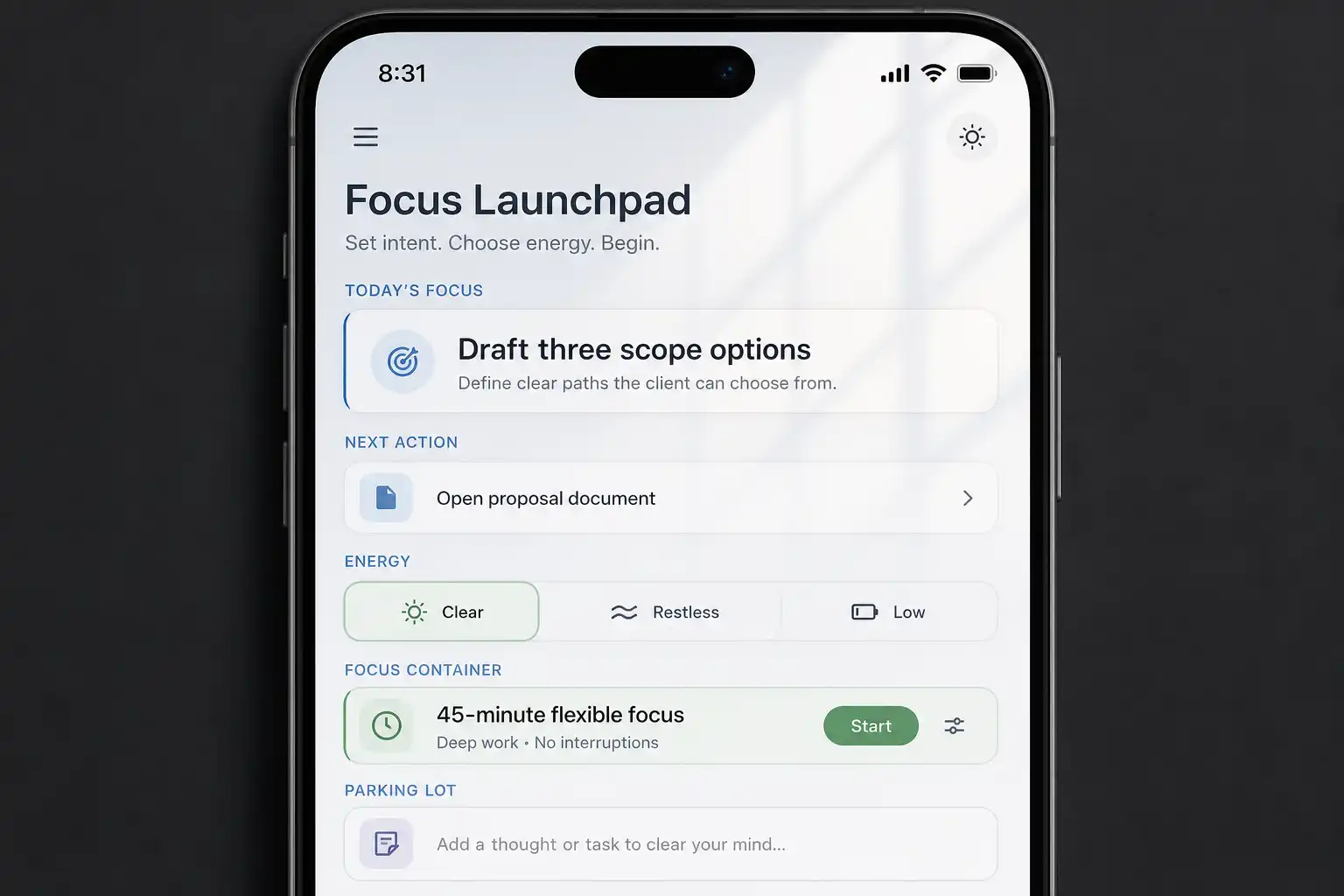
A launchpad is a prepared starting point that removes the tiny decisions most likely to send attention sideways, especially on a low-capacity day. Build it at the end of the prior work block or during a calmer planning moment.
Keep the launchpad in a pinned note, on a paper card, or in a saved task view. Include these six items.
- Today’s finish line in one sentence
- The next physical action that takes under five minutes
- The files and links required to begin
- A parking lot for unrelated ideas and requests
- The first distraction boundary, such as a phone in another room or a closed inbox
- A restart cue, such as “When I return, write the first rough paragraph”
Put this where it appears when you sit down, rather than hiding it behind six clicks in an elaborate workspace. Good organization that delays starting is still friction.
Recommendation software earns its place only when it reduces a decision instead of creating another dashboard to maintain. OwnTime can capture a task quickly, retain its context and approximate timing, and suggest a reasonable next action when spare time appears; that is more useful than asking a tired person to re-rank 40 tasks from scratch.
Match the task to the state you are in
There is no need to turn every afternoon into a quantified energy experiment, but an honest read on your current state prevents a two-hour writing block from becoming 40 minutes of tab-switching and self-criticism. Different work needs different conditions.
| Current state | Choose work that fits | Avoid for now |
|---|---|---|
| Clear and engaged | Strategy, writing, analysis, difficult decisions | Reactive messages and minor admin |
| Restless but capable | Editing, outlining, calls, research with a defined question | Open-ended brainstorming without a boundary |
| Tired or overloaded | Filing, scheduling, invoicing, short chores, a proper break | High-stakes creative work and complicated planning |
| Stuck and anxious | A five-minute entry action, body-doubling, one clarifying question, opening the required form | Rebuilding the entire system |
This filter does not excuse avoiding difficult work indefinitely; it stops premium creative work from being assigned to a brain state that cannot support it today. That distinction matters.
Keep a ready-made menu for low-friction personal tasks, including refilling a prescription, sending a birthday message, starting laundry, booking a repair, and clearing one surface. A fallback menu beats doom-scrolling dressed up as recovery.
Use flexible focus containers
A focus container defines what the work period is for and what will end it, while leaving room to continue when momentum is useful. A timer is optional.
- Set a minimum commitment, such as staying until the opening section exists or working for the next 20 minutes.
- Remove the interruption most likely to derail the block before starting.
- Keep one capture spot for intrusive ideas instead of following each one.
- At the checkpoint, deliberately continue or move to a lighter task or break.
If a useful flow state is still happening and obligations allow it, keep working past the original checkpoint. If the last 10 minutes involved rereading one sentence and refreshing email, the container has exposed the problem and made switching sensible.
A break should lower cognitive load rather than trigger a second attention battle. Water, food, a short walk, stretching, and standing outside are unglamorous because they work more reliably than an “only five minutes” social feed.
Leave an easy re-entry point
How you stop today affects tomorrow’s ability to start, because a vague ending creates another initiation problem. Leave evidence behind.
Before closing the work, spend two minutes recording the following.
- What changed or was completed
- The exact next action
- Any blocker that needs an answer
- Where the relevant file, note, or link lives
For example, write: “Outline complete. Next, draft the case-study paragraph using the notes in the Client Research folder. Ask Jordan for the retention figure.” That note gives the next session a bridge instead of a mystery box.
Avoid endings such as “continue proposal” or “finish later.” Tomorrow deserves more than a vague instruction.
Give work and life separate finish lines
Freelance and founder work comes with a structural catch: nobody consistently decides what matters, notices a drifting afternoon, or keeps personal obligations from disappearing behind client urgency. Freedom still needs rails.
Use two short daily lists rather than one giant master list, with one meaningful work finish line and one life-maintenance finish line. The second could be paying a bill, making a medical call, ordering a prescription, or planning dinner.
Put both outcomes in the actual day instead of leaving them in a database that only records intentions. When attention is strong, tackle the highest-value finish line; when it falls, use the prepared lighter task or take a proper break.
The aim is to make the next useful action visible enough to return to on an uneven day, rather than chasing perfect consistency or an airtight schedule. Check the launchpad before building another productivity system.
Related articles