 OwnTime
Work Habits That Survive Interruptions
Work habits fail for practical reasons
A habit that depends on flawless 9:00 a.m. discipline will collapse the first week a meeting runs long, an urgent request arrives, or attention is spent by noon. That is ordinary work.
The goal is a behavior with a decent chance of happening when the calendar gets messy, rather than a routine that looks tidy in a LinkedIn post. In a 2024 diary intervention with employees, greater automaticity in a new work behavior was associated with higher daily work engagement and goal progress. Implementation intentions increased how often people did the behavior, which supported automaticity. A few helpful actions can stop requiring a daily internal negotiation.
1. Pick one behavior, not a personality upgrade
“Be more proactive” sounds useful, yet it gives a tired Tuesday brain nothing concrete to complete. It is an aspiration. Choose a small action with an obvious start and a payoff you can see, preferably one that reduces recurring friction or prevents a small issue from becoming Friday's problem.
| Vague goal | Workable habit |
|---|---|
| Stay on top of projects | After a project meeting, record the next action and its owner before opening another app. |
| Focus better | Before starting a priority task, silence chat notifications for 25 minutes. |
| Communicate more clearly | Before sending a status update, state the next step and who owns it. |
| Avoid an overwhelming inbox | At the end of a work block, turn each email that requires work into a next action. |
The best first work habit usually makes tomorrow easier instead of trying to squeeze extra output from today. Closing a loop pays forward.
2. Turn the habit into an if-then plan
An implementation intention gives the behavior a recognizable trigger, so it does not depend on remembering a vague promise at the right moment. The format is simple.
If [a recognizable situation happens], then I will [do one concrete action].
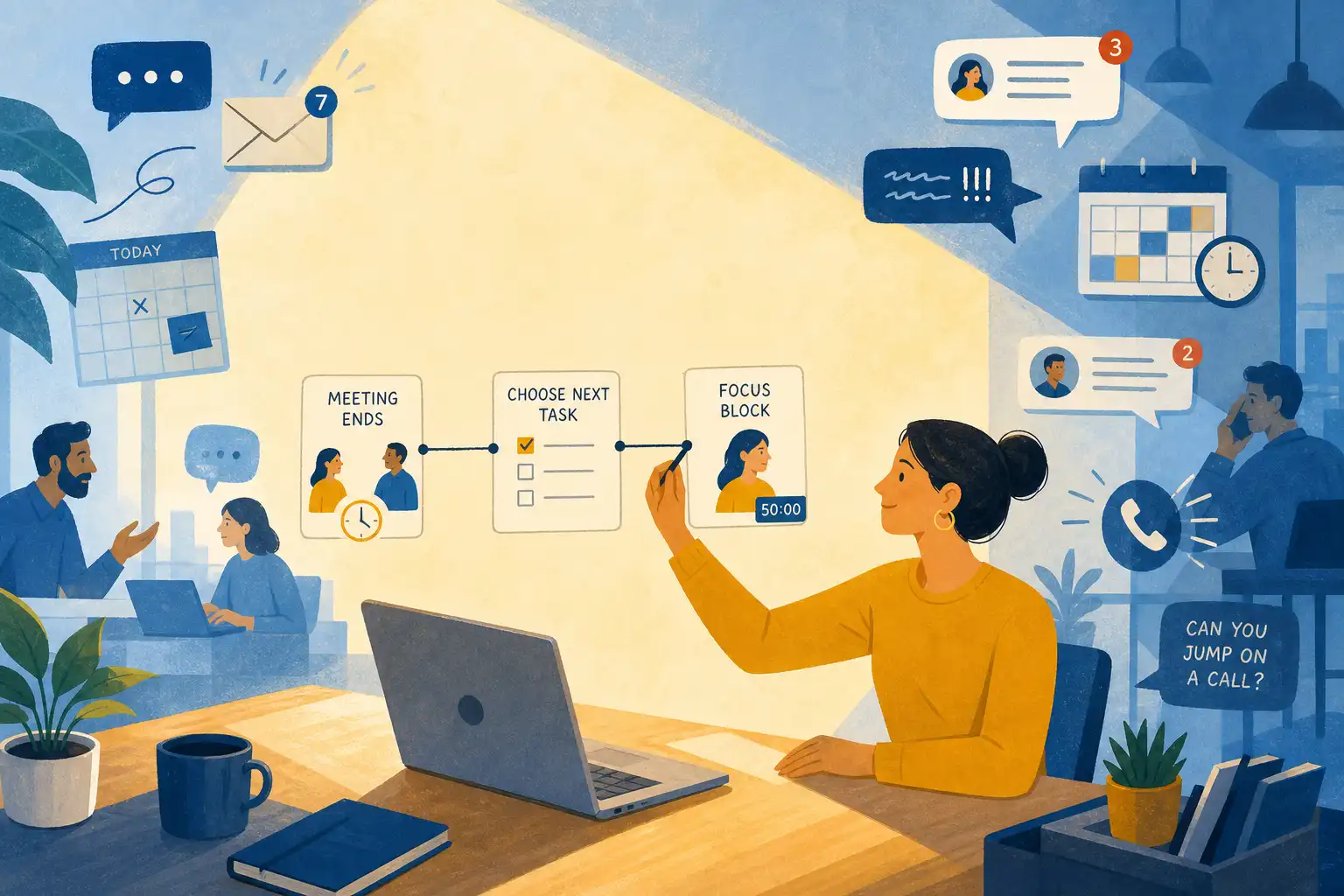
For example, “If I finish my first meeting of the day, then I will spend three minutes choosing my most important next task” names a clear cue and keeps the action bounded.
This has evidence behind it. In a workplace field experiment, Holland, Aarts, and Langendam found that implementation-intention planning improved recycling behavior, with effects still visible 2 months later (2006 study).
Write the plan literally enough that another person could tell whether it happened. “When I have time, I will organize my notes” is too foggy to use.
Make the action smaller than the ambition
When a habit takes an hour, it probably belongs on a project plan rather than in a habit system. Keep the habit to the setup move. That might mean opening the document, blocking a focus session, sending the first question, or defining the next physical action.
3. Use cues that survive a real calendar
Clock-based cues can work when the time is protected, but they fall apart during weeks packed with calls and shifting deadlines. A calendar rarely stays still.
Pick a cue that moves with the workday instead.
- After a client call ends, capture follow-ups before opening chat.
- When sitting down after lunch, open the project brief before email.
- When reconnecting to a task after an interruption, read the next-action line first.
- When noticing task avoidance, write the next physical action before switching away.
Event cues tend to travel better than time cues because they happen wherever the day lands. Keep the action attached to a cue you actually notice. A five-step stack after coffee creates a tiny traffic jam of good intentions.
4. Create a minimum version for interruption-heavy days
Interruptions do different kinds of damage depending on the task they break and the overload they create. Frequency alone does not explain the cost.
Build two versions of the habit before the disrupted day arrives.
- For the standard version, spend 10 minutes after a project meeting recording follow-ups.
- For the minimum version, record one next action before moving on.
Maya plans priority work after her morning check-in, then a customer escalation turns that check-in into an hour of firefighting. She uses a fallback rule: “If the check-in runs over, I will choose one priority before my next scheduled commitment.” The full plan waits.
That is the tradeoff. She gets less strategic planning that day, while keeping the cue-to-action connection that makes restarting possible next time.
5. Remove friction from the first move
Willpower is a shaky production dependency, especially at 4:40 p.m. Make the desired action easier to start than reopening chat or scrolling a feed.
Prepare the starting point before you need it. Keep a meeting-follow-up template, pin the project document, save a short review checklist, or leave the next action at the top of the task system. Leave the first move obvious.
In OwnTime, work tasks can be captured as they arrive, while recommendations can surface a sensible next action around the calendar and recent activity. That reduces the draining “what should I do now?” moment after an interruption. Tools should lower activation energy, not create another dashboard to maintain.
6. Protect the habit from predictable derailers
No team can prevent every interruption, although most people can decide what happens around the interruptions they see coming. A small boundary is enough.
Match the protection to the habit.
- For a focus-start habit, set chat to do-not-disturb for the first 15 to 25 minutes.
- For a follow-up habit, leave the meeting notes open until one next action is recorded.
- For a shutdown habit, add a calendar hold 5 minutes before the usual stopping point.
- For a learning habit, queue one short resource rather than searching for the perfect course.
These boundaries do not require controlling coworkers or rebuilding the whole day. They simply give the intended behavior a fairer chance.
7. Run a five-minute weekly adjustment
Do not score the week as a streak. On Friday, spend 5 minutes reviewing whether the design fit the calendar you actually had. The system should adapt.
- Did I notice the cue? If not, choose a cue that is more visible or happens more often.
- Could I complete the action in the available moment? If not, shrink the standard version or simplify the minimum version.
- What interrupted it most often? Add a fallback rule for that specific situation.
If an “after lunch” routine fails because lunch varies wildly, change it to “after I reopen my laptop following lunch.” That is a more honest plan, not a lower bar.
For the next 5 workdays, mark whether the cue appeared and whether the minimum action happened, then use that tiny record to change either the cue or the size of the step.
Related articles