OwnTime
ADHD Sleepiness: An Executive-Function Triage System
Treat low energy as a capacity signal
On a sleepy day, a 20-item task list can demand more executive function than the tasks themselves, because your brain has to compare urgency, effort, timing, and consequences before it can even begin. Selecting a next step, starting it, and holding it in mind may all feel heavier than usual. That is not a character verdict.
For professionals with ADHD, a normal list can become strangely hostile when it combines urgent work, vague projects, errands, and tasks that matter only if time allows. Start with your current operating conditions instead of trying to force a standard day out of an unstandard brain state.
This is a workday triage system, not a sleep-hygiene checklist or a demand to optimize every night. Its job is to reduce avoidable decisions, protect commitments, and find work your current capacity can carry.
Sleepiness deserves its own check
Sleep difficulties and ADHD commonly occur together, but the relationship is too messy to reduce to “sleep more and ADHD disappears.” A systematic review and meta-analysis of adult ADHD sleep studies found meaningful differences in self-reported sleep problems and some actigraphy measures, while standard sleep-lab measures did not show the same consistent pattern.
Daytime sleepiness also deserves more precision than labels such as laziness. Research on adults with ADHD has examined it as a factor related to cognitive functioning, including attention and performance (daytime sleepiness and cognition). Association is not diagnosis.
Poor or disrupted sleep can make working memory, processing speed, impulse control, and task initiation less reliable on a given day. ADHD already makes these functions variable for many people, so adding sleepiness can make a rigid plan collapse quickly.
Any productivity system that expects identical output every day is badly designed. It works only when life is suspiciously tidy.
Run a 60-second energy triage
Before reorganizing the calendar or declaring the day a write-off, take one minute to assess what is happening right now. A brief check is enough.
Ask:
- Did I get enough sleep to feel reasonably restored, or am I fighting obvious sleepiness?
- Can I hold a short sequence of steps in mind without repeatedly losing it?
- Is there a deadline or meeting that truly must happen today?
- Am I restless and overloaded, sleepy and slowed down, or both?
- Would a task with many open-ended choices feel manageable right now?
Then pick a lane:
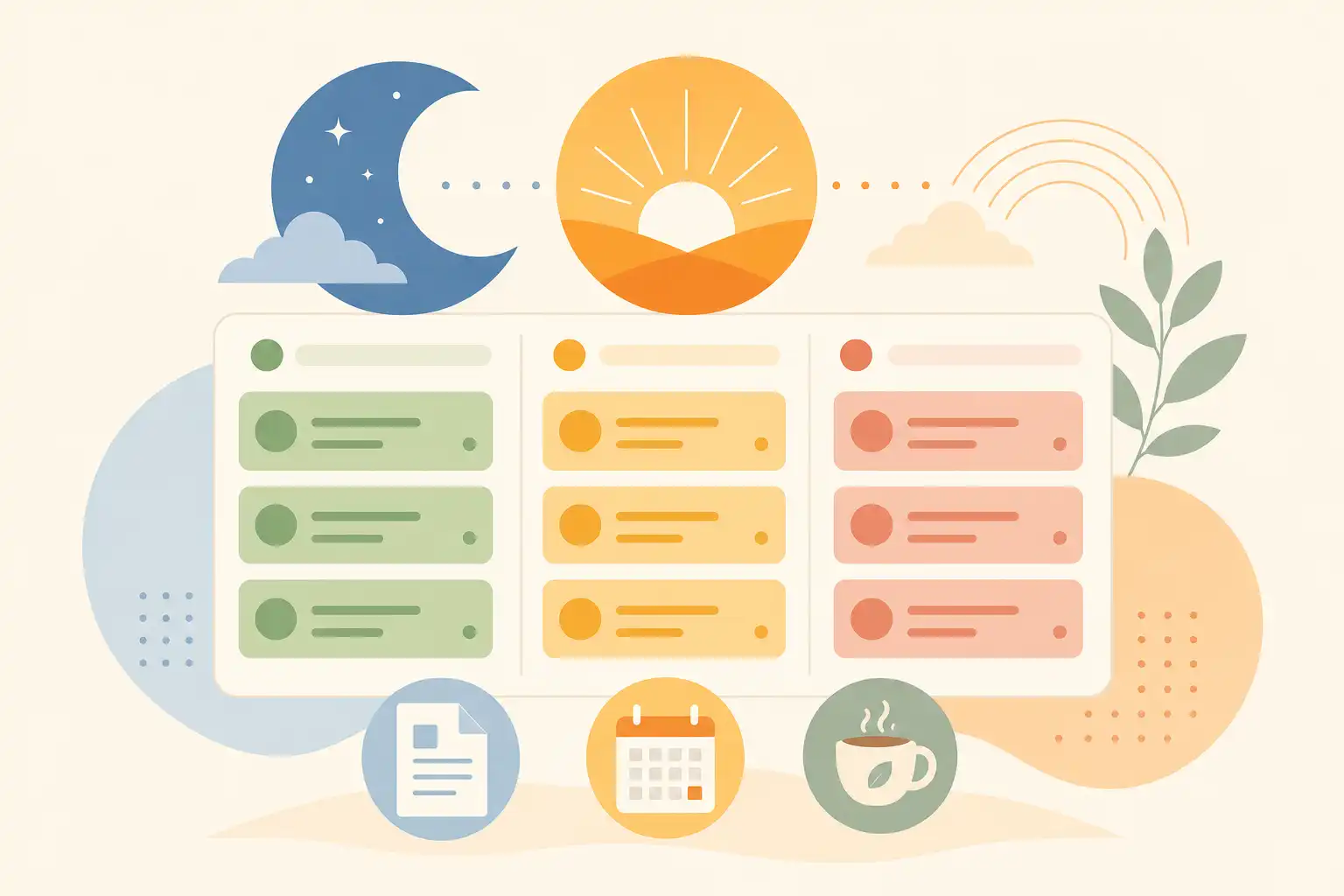
- Green: You are alert enough for planning, analysis, difficult writing, or decisions with consequences.
- Yellow: You can work, especially when the task has clear boundaries, a visible finish line, or another person expecting an output.
- Red: You are struggling to stay awake, rereading the same information, or unable to organize basic steps without major effort.
These labels describe capacity, not worth. Use them only to choose work that fits the day.
Match the task to the lane
Opening every task and hunting for the perfect choice is a trap on a low-energy day. Choose from an appropriate class of work instead.
| Today’s lane | Best-fit task types | Put off if possible | Useful question |
|---|---|---|---|
| Green | Strategy, difficult writing, complex problem-solving, sensitive conversations | Busywork used to avoid meaningful work | “What benefits most from my clear thinking?” |
| Yellow | Meeting preparation, editing, routine follow-ups, structured reviews, one defined project step | Large projects with no obvious first action | “What can I finish or move forward in 20–45 minutes?” |
| Red | Essential meetings, simple admin, basic communication, rescheduling, recovery-supporting tasks | Major decisions, conflict-heavy messages, detailed planning | “What is the smallest responsible version of today?” |
Red does not mean doing nothing. It means preserving essentials and avoiding the extra damage that can come from forcing high-stakes work through a depleted system.
If sleepiness affects driving, operating equipment, or your ability to stay safe, safety is the task. A productivity method cannot compensate for impaired alertness.
Build a minimum viable workday
A yellow or red day needs a minimum viable workday, not a heroic catch-up plan that creates tomorrow’s guilt. Protect what has real consequences, then reduce the activation energy for everything else.
Choose one to three must-happen items
Pick tasks with a genuine deadline, an impact on another person, or a clear ability to prevent a problem from growing. Keep each item concrete.
“Deal with client work” creates fog. “Send the draft, confirm Thursday’s meeting, and flag the one open question” gives the brain three visible actions.
Shrink the first move
A sleepy brain often stalls because a task appears to require 20 decisions at once. Create an entry point that is almost annoyingly small: open the document, write three rough bullets, find the relevant email thread, or set a 10-minute timer for a first pass.
The first move does not need to finish the task. It needs to make the second move easier.
Externalize decisions that can wait
If a task needs good judgment but does not need a decision today, capture it and set a return point instead of rehearsing it mentally all afternoon. Write: “Choose project approach tomorrow morning; review options A and B.”
That note keeps the concern from disappearing while refusing to pretend the decision has to happen in a depleted state. A short shutdown note can also create a cleaner restart point for tomorrow, as described in this ADHD remote-work shutdown ritual.
Reduce the cost of choosing a next task
An unsorted backlog gets expensive precisely when energy is low, because every scroll asks you to judge urgency, effort, timing, and likely consequences. Set up a few task views before you need them.
- Quick wins: tasks with a short, known duration
- Low-focus work: routine actions, errands, admin, and simple follow-ups
- At my desk: tasks needing a computer but little sustained concentration
- Waiting on others: items needing one nudge rather than more analysis
- High-focus: work reserved for a better cognitive window
OwnTime is useful here because its recommendations can consider task effort, duration, timing, flexibility, and current context. The point is not to hand over judgment; it is to remove needless sorting when your decision-making battery is already low.
Whatever task tool you use, give future-you a recognizable next action. “Quarterly report” creates fog, while “find last quarter’s metrics and paste them into the draft” creates a doorway.
Track patterns worth bringing to a clinician
One bad night happens. Two weeks of repeated poor sleep, heavy daytime sleepiness, and worsening work function is useful information.
Keep a lightweight note for 14 days:
- Rough sleep and wake times
- How restored you felt on waking
- When sleepiness appeared during the day
- Which tasks became unusually difficult
- Caffeine, alcohol, medication timing, or other factors you want to discuss
You are looking for patterns, not a perfect dataset. A simple phone note is enough.
Consider a medical conversation if sleep difficulties are frequent, you wake unrefreshed despite enough time in bed, you regularly fall asleep unintentionally, or sleepiness affects safety. Loud snoring, breathing interruptions, uncomfortable leg sensations, and persistent daytime sleepiness also belong in that conversation; clinical guidance on ADHD includes screening for co-occurring sleep issues because they can mimic or worsen attention-related symptoms and may need their own treatment path (overview of sleep issues in ADHD).
Do not change prescribed medication based on a task-system experiment. Bring the pattern to the clinician who manages your care.
Use the plan that fits today
High-capacity days are for work that needs clear thinking. Low-capacity days are for protecting commitments, choosing bounded tasks, and leaving a clean trail for the more-rested version of you.
That approach does not require proving that biology, stress, or a rough night can be overridden through determination. It gives the day a sensible shape and keeps tomorrow easier to enter.
Related articles
ADHD Task Switching: 6 Founder-Friendly Transition Scripts

ADHD Shutdown Rituals for Remote Work
ADHD Productivity: 7 Rules for Closing Open Loops
Obsidian vs TickTick: Habits Need Less Tracking
Time Management for Students: Practice, Not Perfect Plans
ADHD Routines: 7 Systems That Resist Procrastination