 OwnTime
Time Management for Students: A Sunsama Planning System
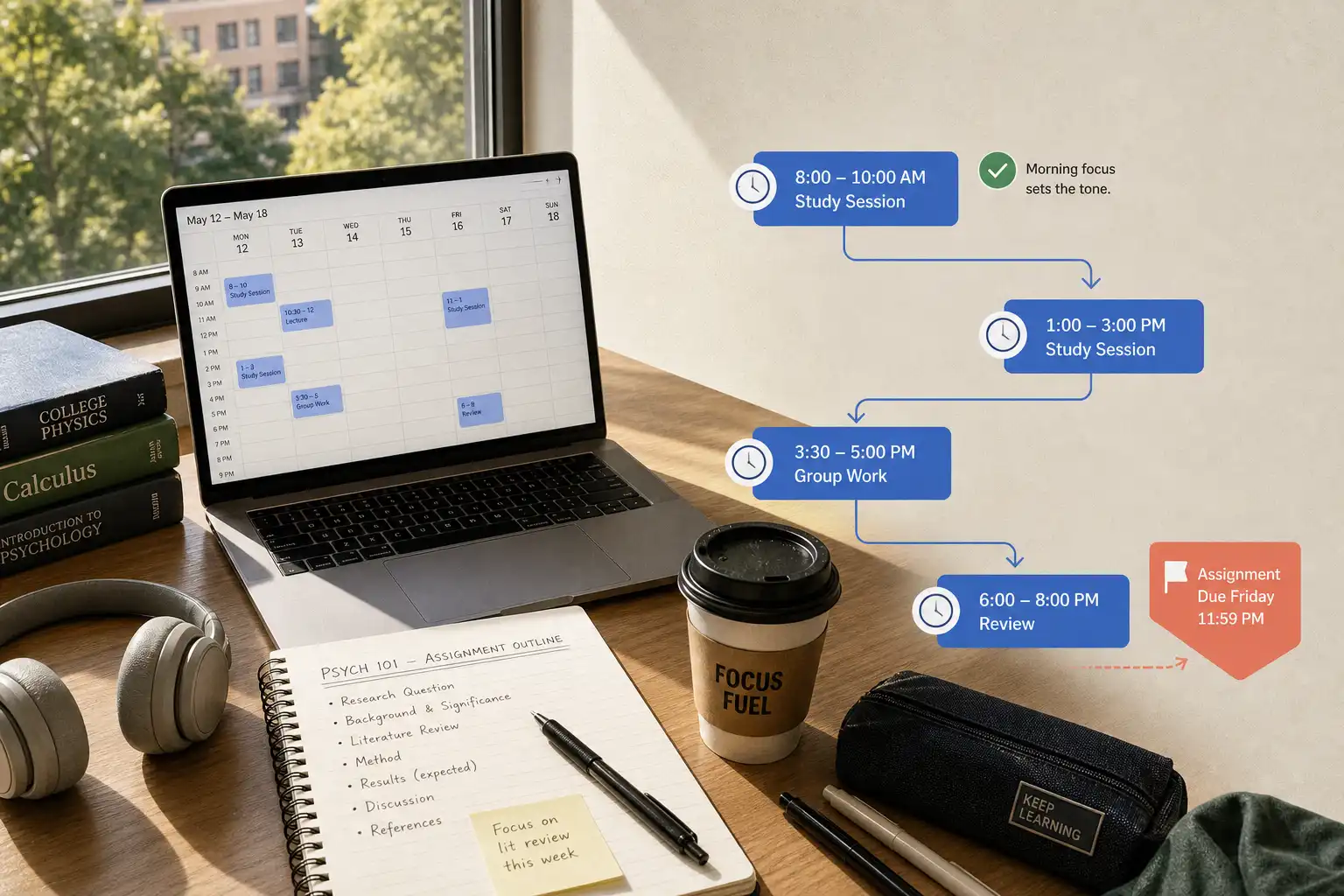
Time management should remove choices
A useful student plan tells you what to do during the 45 minutes between lectures, when a deadline is close and your energy is low. That is the goal.
A colour-coded calendar can look impressive while creating more work than it saves. The better system reduces the recurring choice between reading, outlining, messaging a tutor, revising notes, buying groceries, and beginning the assignment you have avoided all week.
Sunsama is well suited to this job because its daily planning flow puts tasks beside calendar commitments, asks for time estimates, and shows when a day no longer fits. Treat it as a decision-making surface, not a scorecard for your worth.
Planning helps, but reminders are not enough
Time management can support academic performance, though it will not solve every problem that affects grades. A 2026 meta-analysis covering 31 studies and more than 13,000 college students found a moderate positive relationship between time management and learning outcomes, placing planning among the useful parts of self-regulated learning rather than presenting it as a cure-all. Read the review.
Implementation matters. A large study of low-touch scheduling support, reminders, and optional coaching found no meaningful overall effects on grades, credits earned, or retention, even though many students used the programs. The results are a useful warning.
Reminders are the weakest form of time management, in this view. They may get you to look at a task, yet they cannot tell you what actually fits today, turn a scary paper into a first step, or help you reset after Tuesday goes sideways.
A working system keeps three things connected: work that matters, the hours you have, and a clear action to begin. That is manageable.
Pick the planning problem you actually have
Copying an elaborate study routine is a quick route to dropping it by week three. Choose the lightest approach that fixes your current problem, then add structure only when it earns its keep.
| If this sounds familiar | Planning focus | What to do in Sunsama |
|---|---|---|
| “Deadlines vanish until the final day.” | Assignment-first | Add each due date, then create short work sessions in the days before it. |
| “My calendar is full, yet I still plan six hours of studying.” | Calendar-first | Bring in lectures, shifts, appointments, and regular travel before picking tasks. |
| “I know the work, but I cannot start it.” | Start-first | Make the first action very small and specify when and where it begins. |
| “One bad day wrecks the whole week.” | Recovery-first | Keep daily priorities limited and reschedule unfinished work without calling it failure. |
Start calendar-first if you are unsure. Free time between classes, after a long commute, or late at night often looks larger on paper than it feels in practice.
Build Sunsama around your actual week
Put fixed commitments into your calendar before adding study tasks, including classes, labs, work shifts, practices, appointments, and travel that reliably cuts into your day. Sunsama can bring those events into the daily view, which makes it harder to plan against imaginary hours.
Next, add academic work as outcomes with individual sessions. “Finish psychology paper” is an outcome; “find three sources for psychology paper — 45 minutes” is work you can place on a real afternoon.
Keep next actions for each course
For every active course, maintain a short set of next actions instead of copying every syllabus item into a giant master list. A Wednesday afternoon needs a visible move, not a museum of obligations.
- Read chapter 6 and mark unclear concepts
- Solve problems 1–8 from the practice set
- Draft a thesis statement
- Find two peer-reviewed sources
- Send one question to the teaching assistant
This list is deliberately modest. It is also far more usable when you have 50 minutes before dinner.
Estimate the session, not the whole mountain
Estimate the next block of work rather than the time required to master a topic. If a problem set might take anywhere from 40 minutes to two hours, schedule a 50-minute attempt and decide afterwards whether it needs another session.
Sunsama's workload view totals the work planned before your preferred finish time. When it shows an overloaded day, trust that warning more often than your optimism; optimism is a poor calendar.
Plan the day in 10 minutes
Plan before messages, coursework, and social media start bidding for your attention, either in the morning or at the end of the previous day. Sunsama's guided daily planning ritual works well here because due dates, unfinished tasks, and time commitments appear in one place.
Use this sequence.
- Review yesterday without drama. Mark completed work, then carry unfinished tasks forward only when they still matter.
- Check today's calendar first. Lectures and commitments define the workable edges of the day.
- Choose one academic priority. Pick the task that would make today feel meaningfully useful even if the rest gets messy.
- Add supporting tasks. Include life admin, but do not allow errands to take over the list.
- Estimate each task. Rough and honest beats precise-looking fantasy.
- Timebox work that needs protection. Reserve a slot for deep study, a difficult assignment start, or work you are likely to avoid.
- Remove or defer something when needed. A shorter list is an agreement you can keep.
A day without lectures still contains meals, transitions, rest, and the slowdown after sustained concentration. Leave buffer space between substantial blocks, because that spare 20 minutes is usually what saves a plan when one task runs long.
Turn coursework into work you can start
“Study for economics” leaves too many decisions open, which is why procrastination can survive even when the stakes are obvious. “Open the practice exam and answer questions 1–5 at the library” gives the task a starting line.
Use this conversion when adding work to Sunsama.
| Vague task | Startable version |
|---|---|
| Study biology | Make flashcards for the cell-signalling lecture for 30 minutes |
| Work on essay | Write a rough outline with three section headings |
| Catch up on readings | Read pages 42–55 and write three margin notes |
| Prepare for exam | Complete one timed practice section and mark missed questions |
For the tasks you resist most, add an if-then plan with a specific cue. For example, “If I finish Tuesday's lecture, then I will sit in the second-floor library and outline the introduction for 25 minutes.”
This technique is often called an implementation intention. Research on mental contrasting combined with if-then planning found that students scheduled more time for pressing academic concerns and reported better time management. See the study.
Mental contrasting adds a practical extra step: name the outcome, identify the internal obstacle, then plan for that obstacle. “I want the outline finished by Thursday; when I want to research forever, I will write imperfect headings before opening another tab” is specific enough to use.
Use a 20-minute weekly reset
Daily planning protects today, while a weekly reset stops major deadlines from appearing as surprises. Reserve 20 minutes on Friday afternoon, Sunday evening, or another repeatable slot that does not require heroic motivation.
Scan the next 14 days for due dates, exams, presentations, and events that reduce your available study time. Then place one or two early sessions for every major item, since starting ahead of deadline week gives you options when a reading takes twice as long as expected.
Check these points during the reset.
- Items with fixed deadlines or strict timing
- Work becoming risky because it needs several sessions
- Days that are already too demanding for deep study
- Tasks that can stay flexible until the daily plan
Do not lock every study block into the week. Reserve the important sessions, leave room for change, and revisit the plan each day when group work shifts direction or an assignment proves larger than expected.
For a wider routine that can handle changing classes and shifts, build a flexible personal system around these weekly and daily check-ins.
Keep the minimum version for hard weeks
Midterms, illness, family responsibilities, and difficult mental-health weeks can make a full planning ritual unrealistic. Keep the system lighter rather than abandoning it.
Open Sunsama, check the calendar, select one must-do task and one maintenance task, then write the first action for each. This takes a few minutes and gives the day a usable shape.
A minimum plan might be “attend lab,” “submit the discussion post,” and “email the professor about the extension,” rather than an attempt to repair every overdue reading at once. Small plans restore traction when a giant catch-up list would simply sit there.
If tasks and commitments live in several places, a recommendation-based planner such as OwnTime can help surface a realistic next task during a spare window. Pick the tool that gets you acting, then put your next 20-minute reset on the calendar before the week fills up.
Related articles

Procrastination: A Habit Reset for ADHD

Sleep and Energy: Stop Tracking the Perfect Bedtime

Remote Work Sleep: 8 Boundaries That Reduce Procrastination

Procrastination and Sleep: Stop the Energy Loop

Procrastination: Microsoft To Do vs Sunsama for Remote Teams
Routines for Students: Build a Flexible Personal System