 OwnTime
7 Low-Conflict Ways to Start ADHD Homework

Why homework procrastination is rarely about caring
A child can care about the grade and understand the assignment, yet still stare at a worksheet for 25 minutes without beginning. That gap is often executive function at work. Starting, holding steps in mind, finding supplies, estimating effort, and switching away from a preferred activity can all jam at once.
At 4 p.m., a broad instruction such as “do your homework” can hide several separate problems while the child and adult are already running low on patience. Everyone is tired.
Use help at the exact point where the sequence breaks, rather than delivering a lecture long before the next assignment appears. The Children’s Hospital of Philadelphia parent guide describes this kind of in-the-moment support as part of organization, time-management, and planning interventions.
Helping is practice, not takeover
Myth: If I remind my child, they will never learn independence.
Reality: External structure can give a child a repeatable route to practice when their skills are overloaded in the moment. That is scaffolding, not takeover.
Myth: More consequences will solve procrastination.
Reality: Consequences can set boundaries, yet they rarely teach a child how to begin work or recover after distraction. Arguments teach little.
The position here is simple. A clever consequence chart becomes productivity theater when it leaves a child without a physical first step for tomorrow’s assignment after the argument ends.
7 low-conflict ways to start ADHD homework
1. Make the first step almost comically small
“Finish your math” names an outcome, while “put the worksheet on the table” names a start a child can physically complete in under 10 seconds. Small is strategic.
Once the work is visible and underway, the brain has less transition work to do before it can engage with the assignment. If your child stops there, the next barrier is now easier to spot.
2. Use a short co-start, not an all-night hover
Sit nearby for the first two to five minutes while your child gets materials out and picks the first item. Then step away. Try saying, “I’ll stay while you open the assignment, then I’ll check back after two questions.” Predictable support gives the launch some structure without making you the homework manager.
3. Build one repeatable landing zone
A designated spot reduces the daily hunt for pencils, chargers, worksheets, and a usable surface before work can even begin. It can be modest.
CHADD recommends letting children help set up their workspace, keeping needed materials close, and reducing distractions that can knock homework sideways before it starts. Their homework-space checklist is useful.
4. Put the plan where the work happens
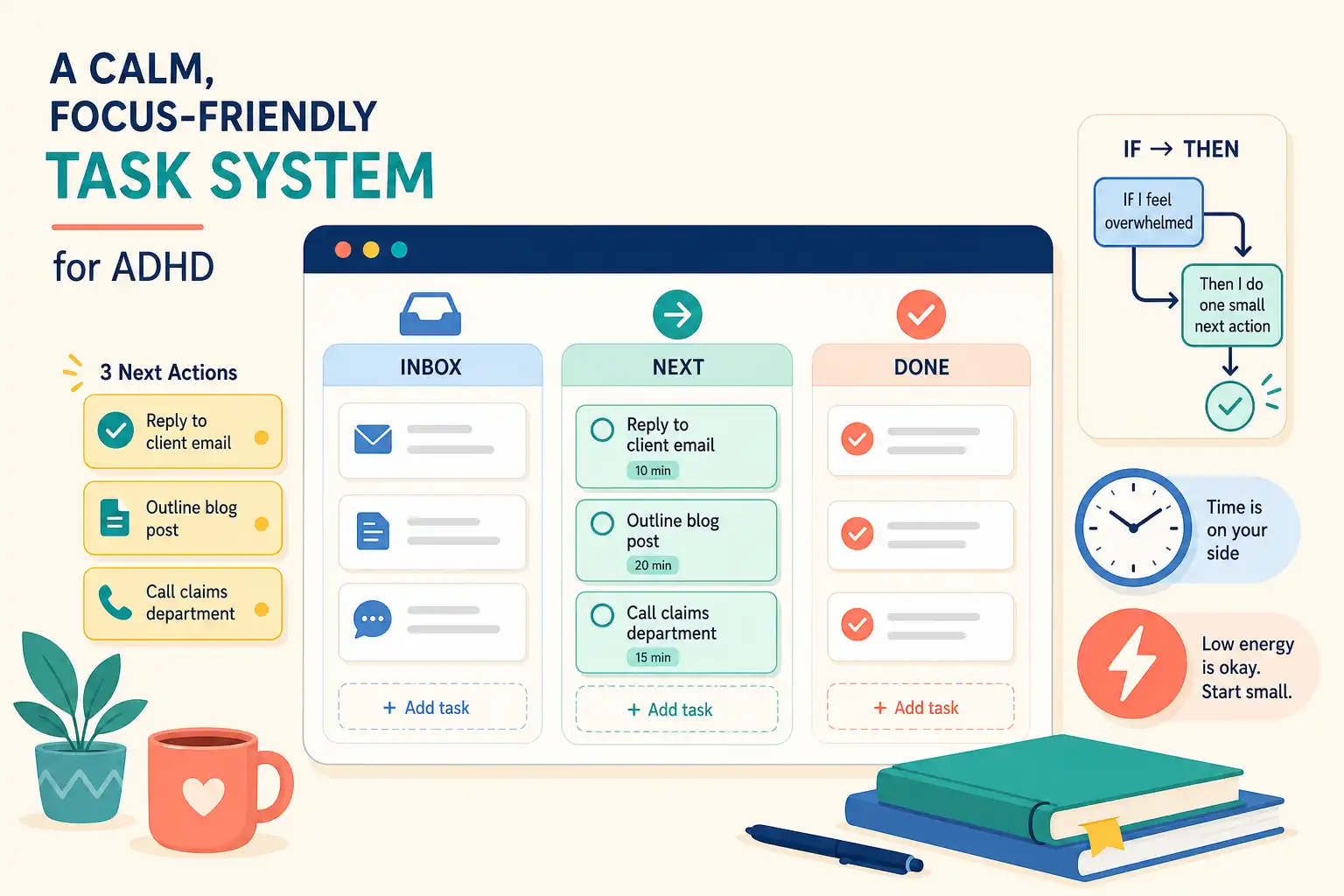
Do not require a child to remember a multi-step plan while they are also resisting a difficult assignment and trying to locate the materials. Put the next actions beside the work.
A visible plan might look like this
- Check the school portal
- Work on science for 10 minutes
Keep it brief enough to read at a glance after a hard school day. A plan that needs its own planning session will not survive a weekday afternoon.
5. Offer bounded choices
Bounded choices give a child some control while keeping the homework decision from becoming a fresh negotiation every evening. Ask, “Reading or math?” Avoid asking whether they want to do homework when that decision has already been made.
6. Make time visible and finite
“Work until it is done” can feel endless when a child cannot yet judge how long the assignment will take or what effort it will require. Use a visible timer.
Start with a 10-minute focused block, then reassess whether another defined sprint is needed. A finite block is easier to accept.
7. Praise the process you want repeated
Specific feedback helps a child notice the actions that made progress possible, especially when the assignment itself felt rough. Generic praise can miss.
Try, “You came back after the timer,” or “You put that paper in your folder without another reminder.” It shows the skill. The goal is to make an invisible process easier for your child to recognize and repeat.
Match the support to the stuck point
Track the exact point where homework stalls, because the right response depends on whether the snag is starting, organizing, returning after a break, or turning work in. Use this quick match-up when the evening gets messy.
| If you notice this | Try this support |
|---|---|
| They cannot begin | Shrink the task to one physical first action and co-start for a few minutes. |
| They lose papers or supplies | Create one travel folder and one stocked homework station. |
| They melt down at a large assignment | Write the next actions down, then use a short timer. |
| They drift after starting | Add a brief check-in after a defined work sprint. |
| They argue about every request | Replace repeated verbal prompts with a visual routine and bounded choices. |
| They finish work but forget to submit it | Add “pack or upload it” as the final visible step. |
Choose one change for week one, so you can see whether it actually reduces friction for this child and this assignment type. Adding a timer, folders, reward charts, a new app, and a detailed schedule at once hides what helped. Nobody can tell.
Fade support without disappearing
Define independence for one narrow step, rather than expecting a whole homework routine to change at once. Maybe it means opening the school portal without a prompt or packing one completed assignment before dinner. Pick one.
Then reduce your involvement in small stages by sitting beside them, moving across the room, checking back after five minutes, and eventually asking them to show their own start plan. Go slowly. This progression gives the child repeated practice using support without another person running every move.
Ask, “What is your first step?” If they cannot name one, offer two workable options; if they can, give them room to try before jumping in.
Keeping adult follow-ups out of your head also lowers the chance that you become the family’s live notification system every afternoon. OwnTime can hold reminders such as “check school portal Tuesday” or “replace pencils.” Fewer live prompts.
When to bring in the school or care team
If homework regularly takes over the evening, causes intense distress, or seems far out of proportion to the assigned work, share the pattern with the teacher. Bring a record.
Write down how long starting takes, which work triggers the stall, what you tried at home, and what happens afterward. Details beat vague reports.
A coordinated school plan can include clearer assignment communication, smaller chunks, a home-school folder, and extended time when appropriate. The CDC notes that ADHD treatment is individualized and that families may discuss behavior therapy, parent training, and medication with a healthcare provider. Use specifics when you ask for help.
This article cannot replace individualized clinical or school guidance. Use it to reduce tonight’s friction while the right team and accommodations come together.
A calmer start tonight
For one assignment tonight, set out the materials and agree on its first physical action. Co-start for two minutes if the transition is sticky. Aim for a start your child can repeat tomorrow, because that creates a better baseline for the next school night than a one-off flawless session.
Related articles