 OwnTime
Deep Work After Poor Sleep: A Flexible ADHD Plan

Poor sleep changes today's assignment
After a poor night, a task that needed 90 minutes of clear thinking may only be safe as a 15-minute setup task, particularly when ADHD already raises the cost of starting and retaining context. The day still counts. Treat that shift as capacity data, then choose work your brain can finish without setting up an afternoon of scrolling or busywork.
A 2023 systematic review of sleep and neurobehavioral functioning in ADHD found that most included studies reported associations between sleep or circadian processes and functioning, while also flagging limits in the research methods. Sleep is an input, not a character test. Extra coffee and harsher rules rarely recreate a high-energy day, whereas a smaller deliverable can protect attention before an overambitious plan collapses at noon.
Check capacity before choosing the project
Spend one minute checking capacity before opening a demanding personal project, because sleepiness and error risk matter more than a task's place on a wish list. Keep the check practical. Decide whether you can stay awake enough to reason through a choice and whether a careless mistake would carry a serious cost.
Use three labels.
| Capacity | Best type of focus | Example personal task | Completion signal |
|---|---|---|---|
| Green | Demanding, open-ended thinking | Draft a portfolio piece or plan a trip with several constraints | A meaningful chunk exists or a hard decision is made |
| Yellow | Bounded thinking with a visible edge | Compare two service providers or revise one application section | One defined artifact is complete |
| Red | Maintenance, preparation, or recovery | Gather documents or set out materials for tomorrow | Tomorrow has less friction and today stays safe |
Adults with ADHD can have later or less stable sleep and rest-activity rhythms than controls, and an actigraphy-based study also linked longer sleep latency with poorer selective attention. That makes a quick capacity check sensible. It cannot diagnose the cause of every unfocused afternoon, so use it as a cue rather than a verdict. Read the study summary.
On a red day, heroic concentration is the wrong demand; choose recovery or simple preparation, especially when a lapse could hurt you or carry a costly consequence.
Match the depth of work to the day
Deep work includes the concentrated thinking used to plan a move, compare insurance, study for an exam, draft a meaningful piece, or sort financial paperwork. Duration is a poor proxy for depth. Match the required thinking to today's capacity, not to an idealized version of your routine.
Yellow capacity is where the trap usually springs, because a green-level task feels impossible to enter and then the whole day gets labeled as a focus failure. Reduce the surface area. Compare two providers or revise one application section.
Capacity matching beats brute-force discipline on poor-sleep days.
Shrink the deliverable, not your standards
Labels such as “work on taxes” force hidden decisions when executive function has less margin, including where to begin and when stopping is allowed. Make the finish line visible. Before you begin, write a sentence that defines what done means.
By the end of this session, I will have [one concrete artifact]. I can stop when [a clear condition] is true.
Two examples keep the scope usable.
- “I will have a list of the accounts that need statements, and I can stop when each one has a link or login note beside it.”
- “I will have a rough meal plan for the next four days, and I can stop when the grocery list is complete.”
If you are rereading the same tax email or losing the thread of basic instructions, find the relevant statements and make a category list rather than calculate deductions. Leave calculations for a clearer session. The final analysis waits, while the next session gets a clean starting point and the risk of an avoidable error falls.
Use breaks that bring you back
On low-sleep days, breaks are part of the focus plan because they keep a limited pool of attention usable across more than one work block. Pick the break before you start. Walk to refill water, make tea, stand outside for five minutes, or put away four nearby items.
An “I’ll just check this” break has no physical endpoint, so it can turn a five-minute pause into the rest of the afternoon. Give the return a cue. Before standing up, leave a plain-language note such as “Next, compare plans A and B” or “Next, write rough bullet points.”
Decide the exit before focus runs out
Low energy makes task switching expensive, and a large backlog turns each switch into a fresh prioritization meeting that a depleted brain did not ask for. Pre-decide your exit. When focus runs out, capture the loose end and move either to a simple maintenance task or to rest.
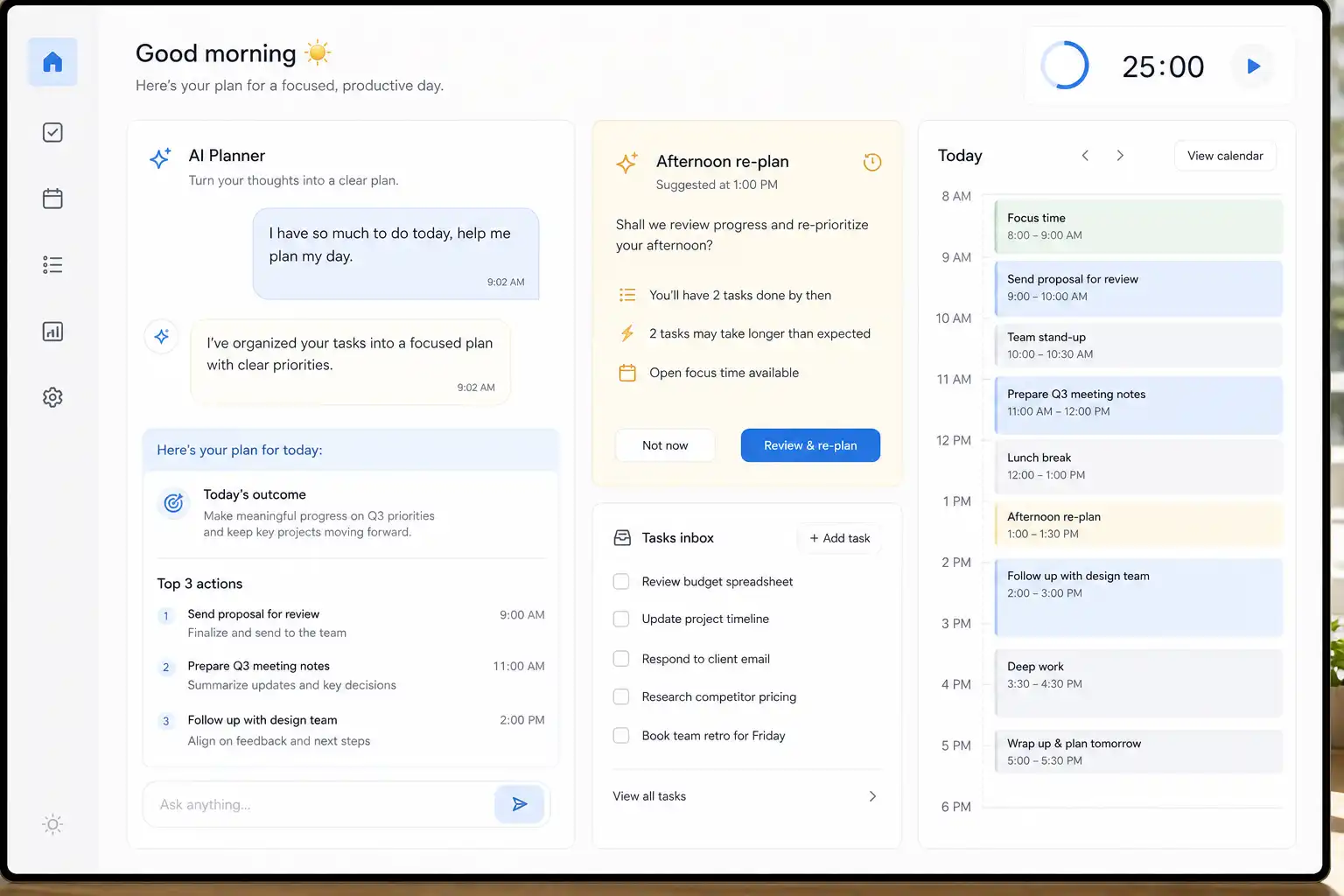
Task recommendations can remove the need to scan every obligation when your mental battery is low. In OwnTime, capture work that surfaced during a focus session, then use recommendations that weigh effort, timing, importance, and completed tasks rather than manually reorganizing everything. This cuts choice overload.
Before leaving, write one sentence that names the finished piece and the open issue, then add a verb-first next action such as “Open the provider comparison sheet and check cancellation terms.” Keep it visible. “Continue project” leaves tomorrow with another decision; a physical action gives it a handle.
Calibrate without turning tracking into a second job
After 2 to 3 weeks, look for broad patterns instead of logging every sleep fluctuation, meal, mood, and output detail. One pattern is enough. Creative work may survive mediocre sleep better in the afternoon, or late-night phone use may make next-morning planning harder.
Do not turn tracking into a second job. The purpose is to make better task choices next week, with less friction on the days when energy is thin.
If poor sleep repeatedly disrupts daily functioning or brings dangerous daytime drowsiness, discuss it with a qualified healthcare professional. On days with drowsiness, skip driving and other safety-sensitive work.
At the end of a low-sleep session, spend 30 seconds making the next action visible before closing the document or putting the papers away. Use a timer if that helps. That small handoff gives a better-rested brain a specific place to restart.
Related articles