 OwnTime
Routines for Parents That Survive Real Life
Start with relief, not an ideal schedule
A 7:20 a.m. bag-packing rule can fall apart the first morning a child wakes late, a shoe disappears, or an email changes the plan. That is normal.
Family routines work best as repeatable sequences that remove a few recurring decisions while leaving room for people to have off days, changing needs, and inconvenient surprises. Aim for calmer rather than perfectly optimized.
Parenting involves constant task switching between work, pickup, snacks, homework, dinner, bedtime, and the basic need to think one complete thought. A familiar sequence gives those transitions a default path when everyone has very little bandwidth.
Pick one pressure point first
Rebuilding every household system on a Sunday night usually creates a pretty plan and a tired Monday. Choose the moment that produces the most rushing, repeated reminders, negotiation, or resentment.
For 3 ordinary days, make a quick note of what happens before, during, and after that moment. Look for recurring friction rather than someone to blame.
- What must happen before the next part of the day can begin?
- What item, information, or decision regularly goes missing?
- What gets delayed until it becomes urgent?
- Which reminder has to be repeated more than once?
A few common starting points appear below.
| Pressure point | Useful routine outcome | Helpful anchor |
|---|---|---|
| Morning departure | Everyone leaves with essentials and less rushing | After breakfast or after getting dressed |
| After-school arrival | Bags, snacks, and decompression happen without a flood of questions | When the door closes after arrival |
| Dinner | Food starts before the household is depleted | When the first adult gets home or a calendar alert fires |
| Bedtime | The house winds down and tomorrow is easier to start | After dinner or after bath time |
| Weekly household reset | Bills, laundry, school messages, and plans stop living in one person’s head | A weekend meal or the end of the workweek |
Routines earn their keep when they replace repeated reminders, especially during busy periods, recurring conflict, or family change. The Raising Children Network makes a similar case for using routines in exactly those moments.
Build around anchors instead of exact times
An event that already happens is usually a stronger trigger than a number on the clock, because “after breakfast, pack bags” still works after a late wake-up. Clock time has its place, but it should not be running the whole show.
Pick one anchor and add a short sequence of 2 to 5 actions. Keep the first version almost boringly small.
An after-school routine, for example, could look like this.
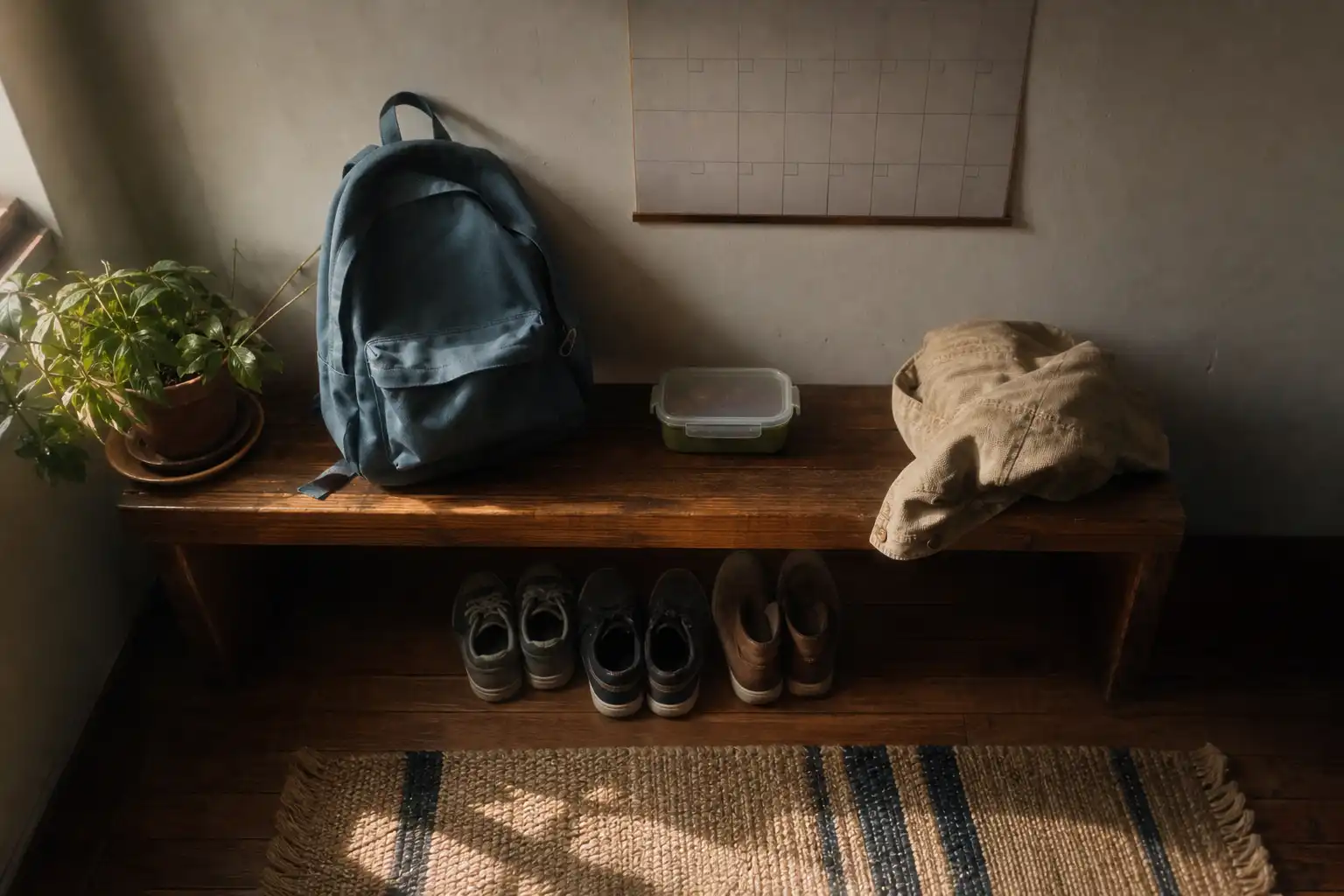
- Put the bag and shoes in their home.
- Have a snack and water.
- Take 10 minutes to decompress.
- Check the next commitment together.
The timing can move around with commutes, school demands, and work schedules, while the recognizable order gives the routine its usefulness. That consistency matters more than hitting 4:15 p.m. every day.
For younger children, seeing what comes next can lower uncertainty and reduce the need for an adult to keep narrating the afternoon. PBS Kids describes consistent routines as a source of comfort and security, and its family routine ideas can help turn the sequence into something visible.
Create a version for low-capacity days
A routine that works only when everyone slept well and work stayed quiet is a fantasy with color coding. Every sequence needs a minimum version.
Write down two levels for the routine.
- Minimum version covers health, safety, tomorrow morning, and basic household sanity.
- Full version includes the helpful extras that fit when time and energy are available.
A minimum bedtime routine might be pajamas, teeth, medication when relevant, one brief connection moment, and lights out. The fuller version can include a bath, reading, laying out clothes, and packing tomorrow’s bag.
This approach keeps care repeatable when capacity is limited rather than lowering expectations for care. On a rough Tuesday, the minimum version keeps the wheels from coming off.
The same principle helps with housework. “Reset the kitchen” is vague after a long day, while “load the dishwasher, wipe one counter, and set out breakfast” gives the brain a clear finish line.
Keep the order flexible and protect the essentials
Myth: A good routine happens at the same time every day
Clock-based schedules are useful for school start times, medication, appointments, and pickup windows. Applying that same precision to every family task often adds stress without solving much.
Reality: A good routine protects the order of the important steps
A flexible routine says that certain things generally happen after a particular event, even when dinner lands at 5:30 one day and 7:00 the next. A disrupted afternoon becomes an adjustment instead of proof that the whole system failed.
Use three labels when deciding what gets attention. Fixed covers appointments and school drop-off; flexible but important covers tasks such as grocery planning, movement, laundry, a family meal, and school messages; optional means useful work that can wait without creating a larger problem.
Paid work, care work, household labor, and personal needs all compete for the same narrow windows, particularly around mornings and evenings. U.S. Bureau of Labor Statistics time-use data makes the obvious point visible: household work is work, and a routine should account for it openly.
Make the routine shareable
A family routine cannot stay in one adult’s memory indefinitely, especially when care is shared with a partner, relative, or another caregiver. Name who handles each step and define what “done” means before the rushed moment arrives.
Children can take on parts that match their age and ability. A preschooler can put shoes in a basket, while an older child can check tomorrow’s schedule or refill a water bottle.
Reduce unnecessary choices at the busiest points in the day. “First clothes, then breakfast” gives a clear path, and “blue shirt or green shirt?” preserves a choice that a child can actually use.
Visible cues reduce the need for an exhausted adult to deliver the same speech again. A checklist by the door, bins for school items, a recurring calendar event, or a simple picture sequence can all work, though any cue that demands constant maintenance needs simplifying.
Decide what happens when plans break
Chaos does not need prevention; it needs a prepared next step. Set a response for a yellow day and a red day before either one arrives.
On a yellow day, leave the laundry unfolded and choose an easier dinner. On a red day, skip nonessential tasks, send one necessary message, and move directly to the minimum bedtime routine.
This protects personal time too, because every delayed task does not need to be crammed into the final 30 minutes of the night. Rest belongs in the plan, particularly after a difficult day.
Take 10 minutes once a week to ask, “Where did this run smoothly or get stuck, and what one change would make next week lighter?” Keep the review practical and blame-free as children grow, school demands shift, and work gets intense.
Let tools carry the reminders
Put fixed commitments in a calendar, then keep flexible household tasks available without pretending each one deserves an exact time slot. A recommendation-based planner can surface a sensible next action when there are 10 spare minutes, which is often more useful than scanning a giant backlog while tired.
In OwnTime, tasks such as “check school email,” “start a laundry load,” and “plan Thursday dinner” can be captured quickly alongside imported family calendar events. The app can then recommend an appropriate next step around what is already happening, leaving fewer reminders stuck in someone’s head.
Choose one pressure point this week and make its minimum version obvious enough to use on a bad day. A routine that bends with the household has a far better chance of lasting.
Related articles
ADHD Executive Function Routines: Science, Not Strict Schedules
ADHD Executive Function: Sunsama vs Notion for Parents

7 Low-Conflict Ways to Start ADHD Homework
Notion vs TickTick: ADHD Time Management That Sticks
Routines That Protect Sleep Without Losing Flexibility

Microsoft To Do Routines for ADHD Beginners