 OwnTime
Routines That Protect Sleep Without Losing Flexibility
Build around anchors, not perfect days
A 10:30 p.m. wind-down cue will outlast a color-coded plan that falls apart when a client calls at 6 p.m. That is the bar.
Founders and freelancers can move from a client escalation to family logistics with focused work squeezed into the gaps, so a useful routine has to survive changing inputs. Hours move.
A routine that works only on a perfect Tuesday is productivity theater. The better version is a small set of repeatable cues that makes the next decent decision easier when the plan goes sideways.
What sleep research actually supports
Sleep research supports regularity, while leaving plenty of room for different chronotypes and work realities. There is no universal hour. Your stable schedule may look different from your cofounder's and still serve you well.
A systematic review of 41 studies involving 92,340 adults found that later sleep timing and more variable sleep patterns were generally associated with worse health outcomes. Certainty was limited. The authors rated the evidence from very low to moderate and could not define one threshold for excessive variability.
Research on daily activity rhythms points the same way. In an observational study of residents in retirement communities, steadier routines were associated with falling asleep sooner, better sleep efficiency, and stronger reported sleep quality, though the results cannot prove that routines caused the change or apply identically to every working adult.1
The practical call is simple: protect a few repeatable cues around sleep and recovery, then let the rest of the day flex. Keep it light.
Why flexible work can pull sleep later
Traditional jobs come with accidental anchors, such as a commute or a workplace closing time, that quietly structure when people wake, eat, and stop working.
Independent work removes many of those boundaries, which is useful until one late sprint leads to a later wake-up and gradually shifts the whole week. Drift is quiet.
Night work deserves scrutiny when it becomes the default rather than an occasional tradeoff. A 2019 study of internet-based freelancers associated night work with lower work-life balance, lower life satisfaction, and greater emotional exhaustion.2
Treat repeated schedule drift as an operating cost, not evidence of commitment.
Use a small anchor system
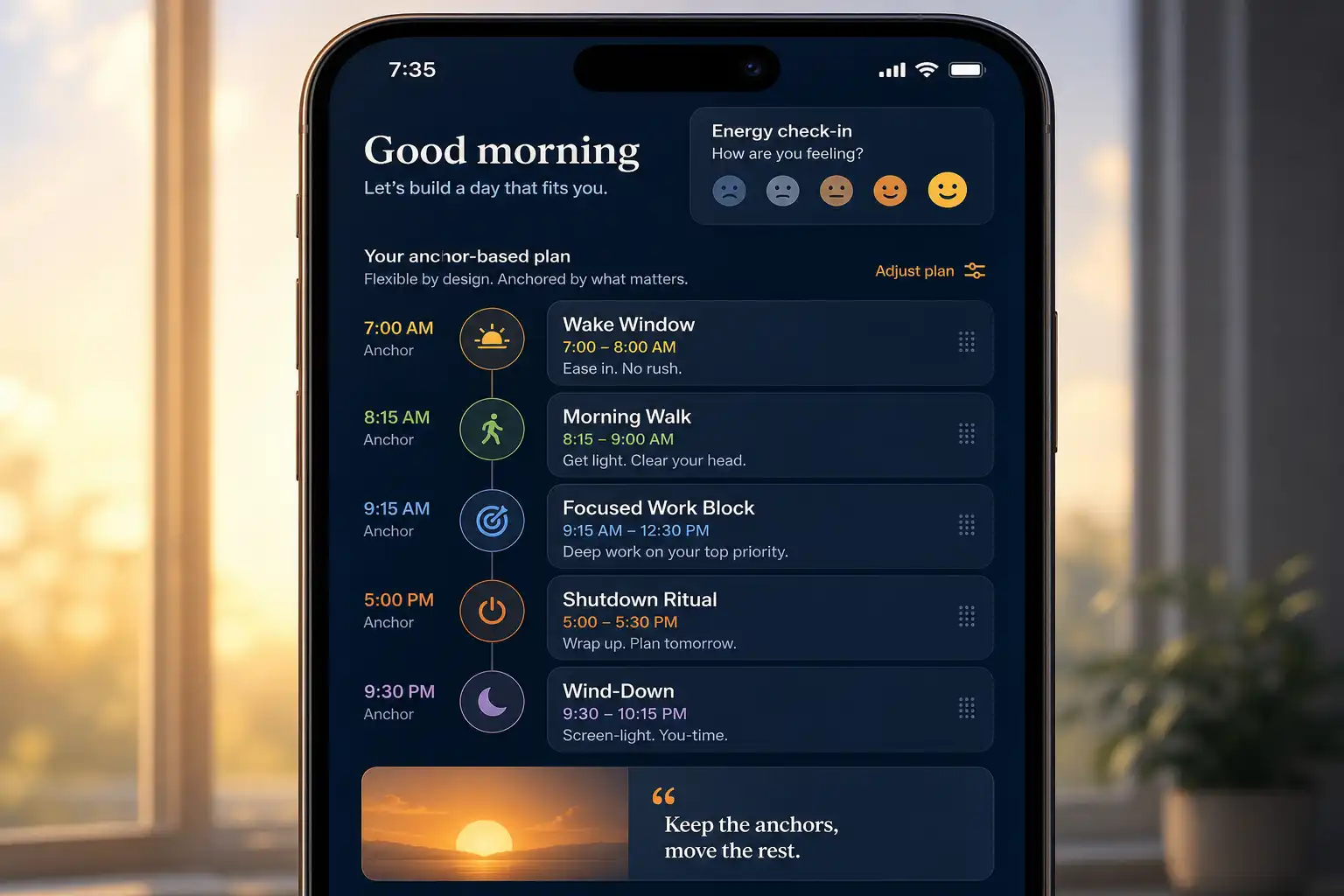
Choose two or four anchors that matter to your sleep and are realistic even when a project goes sideways. Skip the all-day master plan.
| Anchor | What it protects | Flexible version |
|---|---|---|
| Wake window | A predictable start to the day | Use a range instead of one exact minute. |
| First light and movement | A clear shift from sleep to daytime | Step outside, walk the dog, or take a short lap before opening work apps. |
| Work shutdown cue | A boundary around unfinished work | Write the next action and close the laptop. |
| Wind-down sequence | A repeated signal that the workday has ended | Keep it brief with a shower, a few pages of reading, light stretching, or tomorrow's first task. |
The table leaves out an inflexible hour-by-hour schedule for a reason. Sleep timing and recovery should not depend entirely on whether your calendar behaved.
A 60-minute wake window is often more durable than a fixed wake time for people working across time zones or handling care responsibilities. That range helps.
Get first light before work apps whenever practical, even if it means standing outside for five minutes while the kettle boils. A one-block walk counts.
The shutdown cue may do more for your evenings than another productivity app because unfinished work has a habit of following people into bed. Write the next action and close the laptop. The physical close matters.
Keep the wind-down sequence brief enough to repeat after an ordinary hard day, rather than saving it for a rare calm evening.
Start with the minimum version
Design the minimum routine before designing the ideal one. Five reliable minutes after waking and 10 deliberate minutes before bed beat a 90-minute ritual that disappears during a busy week.
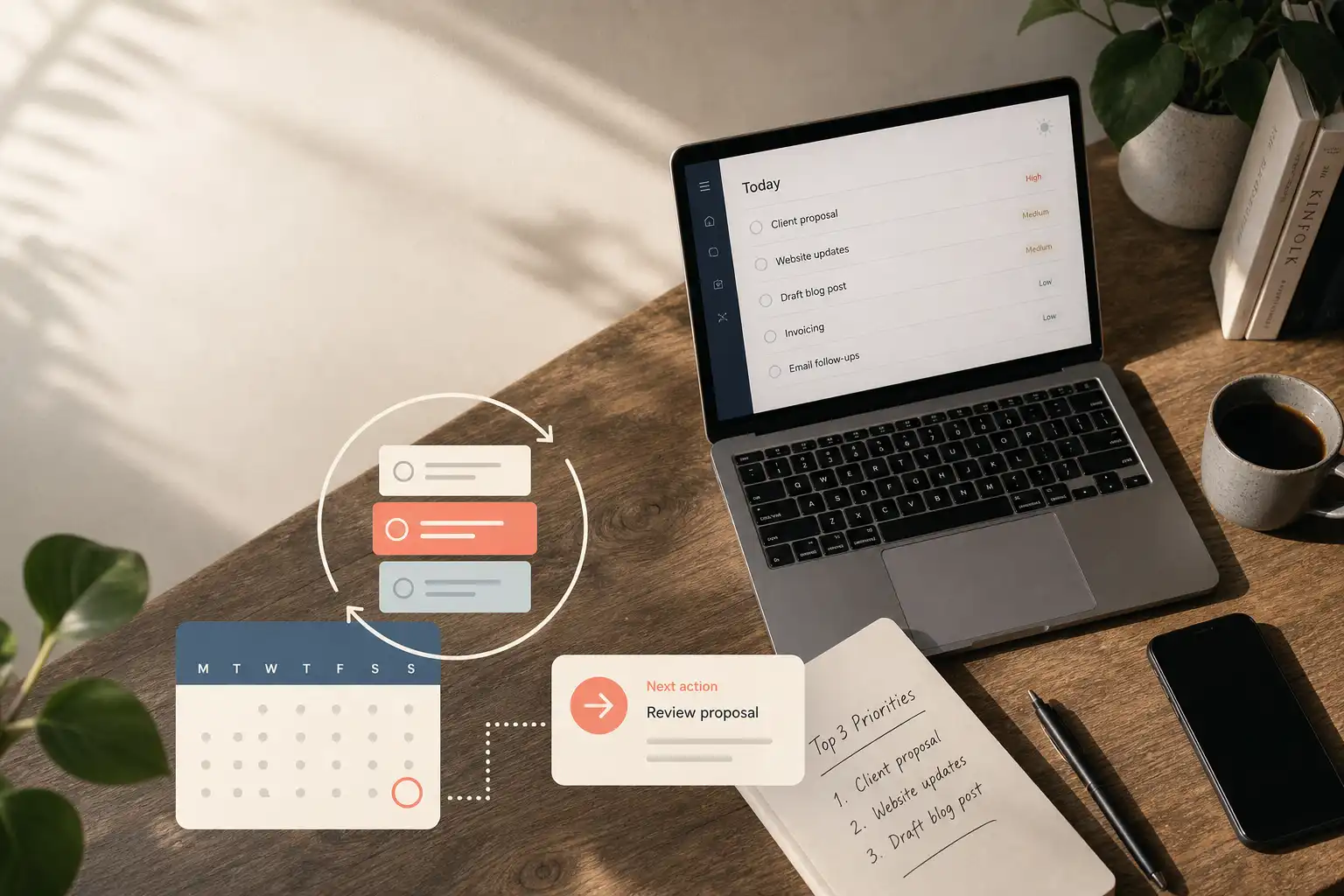
A recommendation-based planner can also keep loose ends from becoming mental tab-hoarding. In OwnTime, capture the follow-up from a late work session, then let the app surface a sensible next task tomorrow.
For a leaner task workflow around those loose ends, this founder to-do-list routine covers how to capture, sort, and review recurring work without turning every task into a calendar block.
Handle disruptions without declaring the week lost
Consider Priya, a freelance product designer whose wind-down usually begins around 10:30 p.m. At 9:45 p.m. on Thursday, a client reports a launch issue and she decides an hour of focused work is worth the tradeoff.
She captures the follow-up, fixes the urgent issue, and skips the optional late-night admin work. Friday is lighter.
Instead of forcing a demanding strategy task through depleted attention, she moves it and returns to her normal wake window as closely as practical. The cost is deliberate.
That is flexibility in practice: bend around a real constraint, then return to the pattern.
Run one 14-day experiment
Do not overhaul sleep habits and your task system in one ambitious Sunday-night reset. Run one experiment for 14 days.
- Pick the anchor that moves around most, such as your wake window or shutdown cue.
- Set a realistic range or a minimum action rather than an exact ideal.
- Track bedtime, wake time, and a one-word rating of daytime energy.
- Record constraints that mattered, including travel, caregiving, illness, or a genuine deadline.
- At day 14, keep what reduced friction and redesign what demanded too much willpower.
Your tracking does not need polished charts or a perfect streak. It needs to show whether the routine works during a representative week.
Persistent insomnia, severe daytime sleepiness, or mood changes that affect work or safety call for more than a routine experiment. Contact a qualified clinician early.
Make tomorrow easier to start
Put a wake window and shutdown cue into place this week, then give them 14 days before judging the system. A late call can still happen.
When it does, capture the next action, make the tradeoff deliberately, and return to the anchor at the next workable opportunity. That approach preserves energy for decisions that deserve it.
Footnotes
-
American Academy of Sleep Medicine summary of the study on daily routines and sleep quality. ↩
-
Shevchuk, Strebkov, and Davis, “The Autonomy Paradox: How Night Work Undermines Subjective Well-Being of Internet-Based Freelancers” (2019). ↩
Related articles