 OwnTime
Work Procrastination: Stop Slippery Deadlines in TickTick

Slippery deadlines are usually a start problem
A TickTick task called “finalise the analysis soon” can sit untouched for weeks because it gives you no obvious first move. That is a design problem. At work, procrastination often appears when the finish line is vague, a decision feels uncomfortable, another person has not replied, or the job has grown too large to enter in one sitting.
You do not need a bigger planning ritual to fix that. You need a small repeatable protocol that turns a loose obligation into a visible action, puts it ahead of inbox triage, and gives you a way back after an interrupted day. TickTick can support this without forcing a complete rebuild of your work system.
A 2025 systematic review of workplace procrastination describes procrastination as a workplace issue with several contributing factors, rather than a simple failure of time management. Blame is not useful here. A better next action is.
Spot the slippery deadline
A hard deadline has a date and a consequence that is difficult to ignore, such as payroll, a client presentation, a board meeting, or a launch. A slippery deadline sounds like “move the proposal forward” or “send a draft when you can.” It can slide without creating immediate friction.
That distinction changes how you plan. Research on self-directed and poorly defined deadlines found that procrastination predicted meaningful delays even when delayed work had serious consequences; in an applied study of arbitrators, people with higher trait procrastination took far longer to produce decisions. Read the study on slippery deadlines and work performance.
Do not manufacture an emergency for every task. Create a sequence of honest commitments while there is still room to think well. That is the whole game.
Drop the beliefs that keep work stuck
“I will start when the pressure is high enough.” Pressure may produce a sprint, yet it also narrows your thinking and makes demanding work feel harsher than it needs to. Set an earlier milestone that creates a small external commitment, such as sharing an outline with a colleague.
“I need the full plan before I begin.” Most knowledge work becomes clearer through contact with the work, particularly writing, analysis, strategy, and coordination. Define one observable action, then let the next action appear after you have evidence.
“A better mood will make this easier.” Waiting for the right feeling hands a difficult task control of your calendar. A 10-minute start is a more dependable trigger.
Here is the firm rule: a task that cannot be started within 10 minutes is not ready for your active work list. It may still matter a great deal. It needs one more layer of translation first.
Build a start-first TickTick setup
The aim is simple: make delayed work easy to find and difficult to rationalise away. Use this setup for projects with movable dates or unclear scope.
| Moment | Set it up in TickTick | What success looks like |
|---|---|---|
| A vague request arrives | Capture the deliverable, then add a subtask that starts with a verb | “Draft four options for vendor renewal” replaces “Vendor renewal” |
| A project has a true due date | Add the external deadline and create earlier milestone tasks | A shareable version exists before delivery day |
| You have a short gap | Open a saved filter containing actionable work only | You see a short set of starts rather than every obligation you own |
| A task is delayed | Replace the next action and set a new review point | The project becomes active again instead of silently overdue |
Capture the deliverable, then write the physical next move
When someone asks for work, record what must exist when the request is complete. Then add a subtask describing the first physical or digital action that moves it forward. Keep the wording concrete.
“Monthly variance commentary” is a category. “Open the variance report and highlight the four largest changes” is a start. TickTick’s quick capture works well here because you can save the request in seconds and refine it later, rather than spending five minutes arranging labels before the work is safely recorded.
Give flexible work a deadline ladder
For a project with a firm final date, create an internal milestone that produces something another person can see before delivery day. If there is no actual deadline, use a review date instead of inventing a promise you do not intend to keep. False deadlines train you to ignore your own system.
A useful ladder has three rungs:
- Start date for opening the task and making the first move
- Share date for sending a draft, question, decision, or status update
- Finish date for the real external deadline, when one exists
Create these as separate tasks or subtasks in TickTick. Add reminders only where a reminder changes behaviour. More notifications are rarely the answer.
Book a short beginning
Put the first action on your calendar for 25 to 45 minutes, preferably during a period with fewer interruptions. Keep the block modest. A two-hour fantasy session is easy to postpone before it starts.
TickTick’s calendar and Focus features can protect that session, while a realistic capacity plan helps you avoid booking six hours of work into a day with four hours available. For a deeper calendar setup, see TickTick Calendar Capacity Planning for Client Work. Stop when the block ends if another commitment needs you.
Create one Start Work view
A huge task list is often an avoidance menu wearing a productivity costume. Build a saved TickTick filter that includes next actions, milestones due within the next 7 days, and tasks that are not waiting on someone else. You should be able to scan it in under one minute.
If the view has 50 items, it is too broad. Archive reference material elsewhere and reserve the highest priority for work with an actual consequence, a promise to another person, or a milestone that must happen now.
Use the five-minute recovery rule after a delay
Missing a self-set target can create frustration, and frustration makes reopening the task less appealing. Research using task data and experiments found that missed deadlines can trigger negative emotions that contribute to further procrastination. See the study on being busy and procrastination after missed deadlines.
Do not punish yourself by cramming replacement tasks into tomorrow. Restore contact with the project in five minutes.
- Open the overdue task in TickTick.
- Write one sentence naming the block, such as unclear scope, waiting for input, low energy, lack of time, or avoidance.
- Replace the old next action with a smaller action that fits the next available work block.
- Set a realistic review date, or tell the relevant person that the commitment has changed.
A delayed task is information about the system around the work. Treating it as a character verdict makes another delay more likely.
Reduce ambiguity with a better conversation
Some procrastination comes from planning. Some comes from missing information. When “good enough” is undefined, starting feels risky because every possible direction can look wrong.
Before disappearing into solo work, ask the person involved four direct questions:
- What decision will this work help us make?
- What should a useful first version include?
- What can wait until a later version?
- When would an early draft or update be useful?
These questions turn private uncertainty into shared project design. They also give your TickTick task a clearer finish line, which is often enough to cut through the fog.
Run a five-day experiment on one task
Do not attempt to repair every work habit this week. Pick one slippery task that has been hanging around, then test the process for five working days.
Day 1 Write the final deliverable and one 10-minute next action in TickTick.
Day 2 Add a share date or review date, then schedule one short start block.
Day 3 Open your Start Work filter before email or chat for the first time that day.
Day 4 If you avoid the task, use the five-minute recovery rule rather than merely moving its due date.
Day 5 Review which condition made starting easier, whether that was a clearer action, a quieter time block, a smaller scope, or someone expecting an update.
Keep the part that produced movement. Let the rest go.
Make the next choice lighter
The goal is not a work life where nothing is ever delayed. The useful skill is noticing a slippery task early, giving it a startable move, and returning without drama after meetings, messages, or changing priorities interrupt the plan.
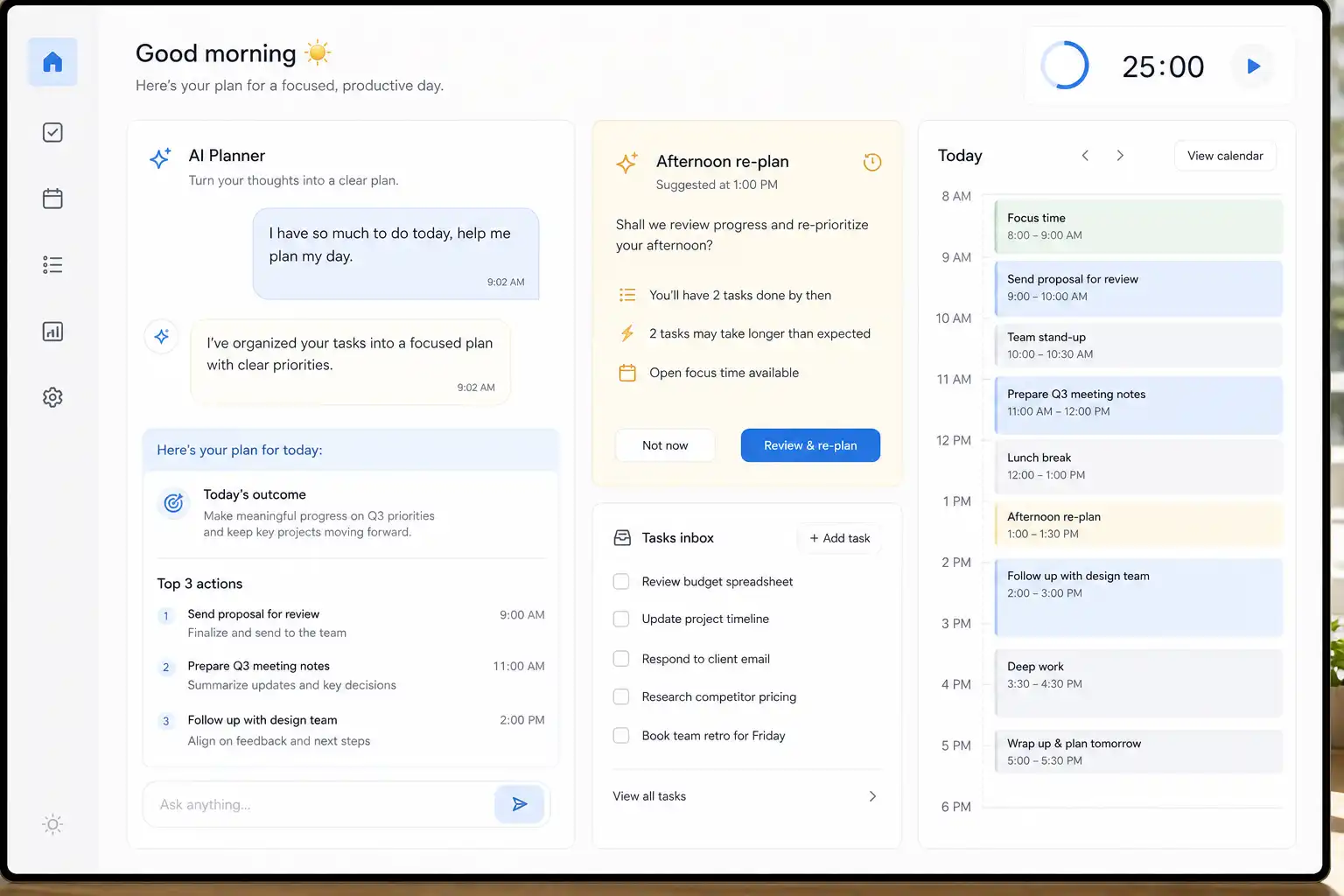
TickTick is a strong choice when you want to shape your own task views, calendar blocks, and milestones. If the repeated bottleneck is deciding what to do while mentally tired, OwnTime takes a different route by recommending next tasks from your wider commitments, which can reduce the effort of re-sorting a list.
Tomorrow, choose one task that has been quietly sliding, write a 10-minute action beneath it, and put that action where you will see it before opening your inbox.
Related articles