 OwnTime
Deep Work at Work: An ADHD-Friendly Calendar Method

Focus time needs room to move
Deep work at work does not mean building a monastery around a desk or disappearing from Slack for four heroic hours. It means giving one meaningful deliverable enough uninterrupted continuity to move forward. That is the useful standard.
For people with ADHD, the hard part is rarely understanding that focus matters; it is returning to work after meetings, requests, messages, and the effort of remembering where the thread was left. A 2005 study of information workers found that 57% of work spheres were interrupted, with more than two other activities commonly happening before people resumed the original task. That is a work-design problem, not a character flaw.
A calendar filled with exact, aspirational focus blocks is usually a tidy-looking route to unnecessary guilt. Focus time should be protected, but it should also be movable. The goal is a reliable lane for important work, not a contract with 9:00 a.m.
Start with a deliverable, not a work category
“Work on the proposal” forces a fresh decision every time it appears on the calendar, and that decision can eat the whole block before meaningful work begins. Pick an outcome another person could recognize when it exists. Make it visible.
Before reserving time, write a deliverable in this format.
By the end of this session, I will have [a visible work product] ready for [the next person or next step].
Here are four useful examples.
- Draft the three recommendation sections for the client proposal.
- Turn interview notes into a one-page decision brief for Tuesday's planning meeting.
- Fix the two failing checkout tests and post the result in the engineering channel.
- Prepare five slides explaining the experiment result for the leadership team.
The deliverable does not need to finish the project. It needs to be small enough to start and substantial enough to matter.
Build three calendar lanes
Rather than assigning every minute of the day, separate work into three lanes with different rules. This gives the schedule somewhere to absorb a surprise meeting without turning the rest of the day into calendar Tetris.
| Calendar lane | What belongs here | How firm it is |
|---|---|---|
| Fixed commitments | Meetings, appointments, deadlines, live collaboration | Firm |
| Focus windows | Writing, analysis, building, problem-solving, preparation | Protected, but movable |
| Shallow-work buffers | Email, approvals, messages, admin, planning, follow-ups | Flexible |
Add fixed commitments first, because pretending they do not exist is how a reasonable plan becomes impossible by 10:17. Then place one focus window near the time of day that most often offers usable attention, even if it lasts only 45 minutes. Leave buffers around it for messages and transitions.
A focus window can move. Its purpose should stay the same.
If a 10:00 meeting lands over a planned 9:30 session, shift that session to the next plausible opening rather than deleting it and hoping “later” works out. When there is no opening, reduce the deliverable and reserve a shorter session. Forty honest minutes beats a two-hour block that exists only in theory.
Make the first minute cheaper
Starting is often where good intentions get spent, especially when work feels vague, dull, or emotionally loaded. Reduce the choices required before beginning. Tiny setup decisions still count as friction.
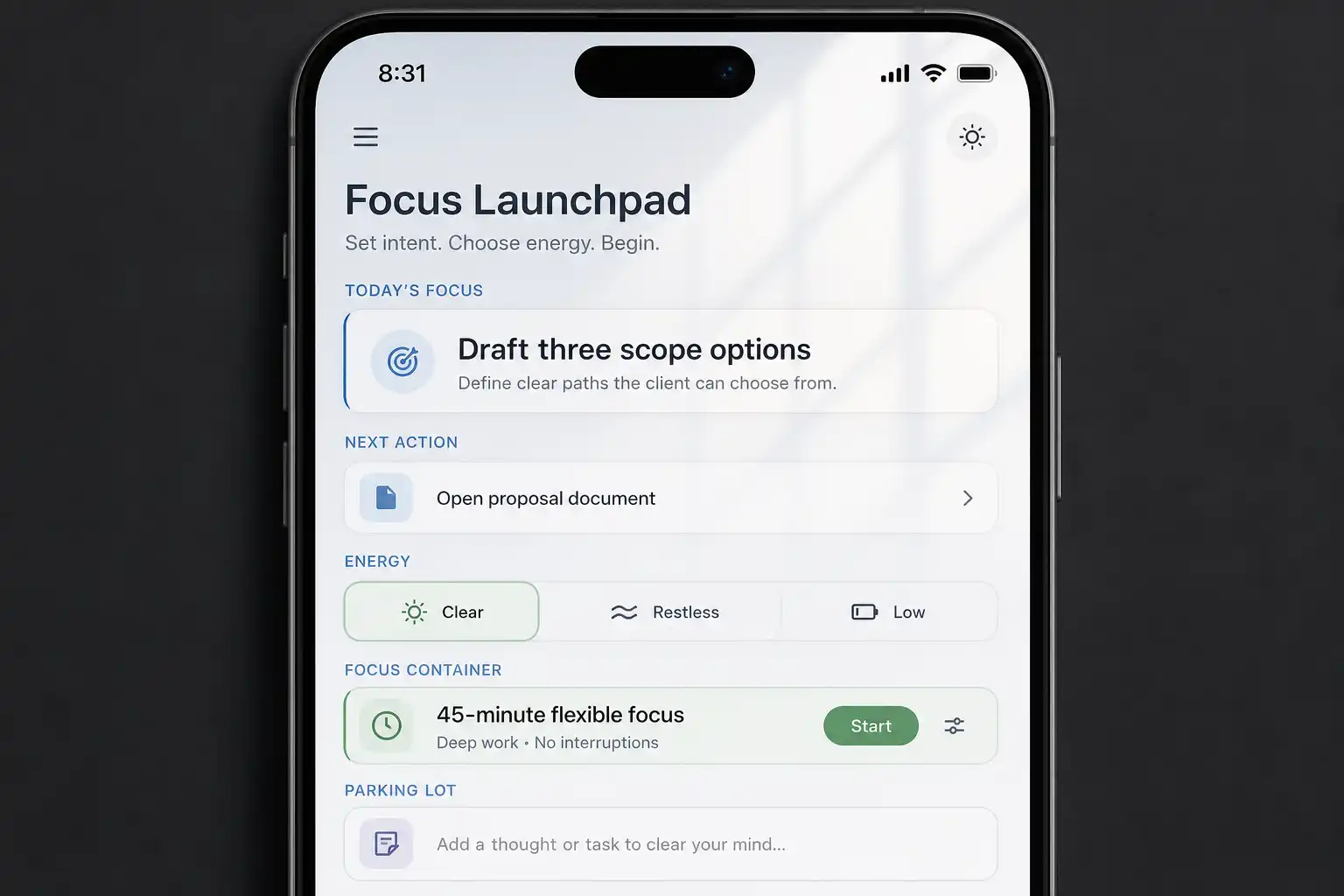
Before leaving a task, prepare four things for the next return.
- Open the document, ticket, spreadsheet, or code branch.
- Write the first physical action, such as “outline the opening,” “compare rows 12–30,” or “run the test suite.”
- Put required links and reference material in one place.
- Close unrelated tabs that are likely to recruit attention.
Set a deliberately non-intimidating timer for 15 or 25 minutes. The aim is not to trap anyone into working forever. Starting should cost less.
When the timer ends, choose whether to continue, take a short break, or move into a planned shallow-work buffer. Visible progress makes that choice easier. It also keeps an imperfect session from turning into a failed-day story.
Protect focus without becoming unreachable
Deep work can coexist with a collaborative job when colleagues have a predictable route for urgent issues. Make the boundary legible. Silence without context tends to create more interruption pressure later.
A status such as “Heads down on the Q3 analysis until 11:00; call or mark urgent if you need a response sooner” gives people a clear rule. It is clearer than quietly vanishing. It also limits the guesswork around whether an interruption can wait.
During the window, reduce the places that can claim attention.
- Pause nonessential notifications instead of relying on willpower.
- Keep email and chat closed when the role allows it.
- Route urgent requests to one channel, such as a call or an urgent tag.
- Keep a scratch note called “not now” for ideas, requests, and tabs to revisit.
That scratch note earns its place because interruptions are not always external; a remembered chore or sudden research urge can break continuity just as effectively as a message. Capture the thought in a few words. Then return to the next action already waiting.
Use a five-minute restart after meetings
A meeting takes more than its scheduled 30 or 60 minutes when it leaves decisions, worries, and action items running in the background. Re-entry has a cost. Plan for it.
After any meeting that cuts through a focus window, use this four-step restart ritual.
- Write down the meeting's next action, if there is one.
- Look at the focus deliverable and read the last note left for yourself.
- Pick one action that takes less than 10 minutes to begin.
- Restart the timer before opening email or chat.
This routine is intentionally boring. Boring is useful here.
The point is to restore the work thread before the inbox takes over, since easier and louder tasks are usually waiting nearby. In a workplace interruption study, participants finished interrupted tasks faster but reported more stress, frustration, time pressure, and effort. Getting something done somehow is not the same as building a sustainable pattern.
For more ideas on handling restarts around changing priorities, see ADHD work habits that survive interruptions.
Review the calendar, not your willpower
Spend five minutes at the end of the week reviewing what the calendar actually allowed, rather than grading the week against an ideal plan. Look for conditions. The schedule is giving useful data.
Review four questions.
- Which times of day produced the easiest starts?
- Which meetings made it hardest to resume focused work?
- Were focus windows too long, too short, or placed in unrealistic gaps?
- What shallow work kept leaking into protected time?
Change one condition for the following week, such as using shorter blocks after lunch, adding a buffer after a recurring meeting, or reserving a quiet location for analysis. Small adjustments beat a full system overhaul. That is how a calendar becomes workable on ordinary days.
A randomized trial of 46 adults with ADHD found that an 11-week work-performance intervention improved self-selected work-goal performance, executive function, and quality of life, with gains maintained at a three-month follow-up. Personal fit was part of the intervention.
When choosing the next task is the bottleneck, a tool that reduces that decision can help more than another planning ritual. OwnTime can keep work and personal commitments together, factor in calendar events and task details, and surface a plausible next action when a focus window opens. The person still chooses the work, while the system reduces the number of tabs, lists, and priorities to sort through first.
Questions about deep work with ADHD at work
How long should a deep-work session be with ADHD?
There is no universal session length, and longer is not automatically better. Start with the shortest window that reliably gets past starting friction, often 25 to 45 minutes. Extend only when the work and energy support it.
What if the job is too meeting-heavy for deep work?
Treat small gaps as intentional sessions when a task has a clean next action, rather than as failed versions of a longer block. Reserve larger work for the least interrupted day, or ask whether a recurring meeting can be shortened, moved, or replaced with an asynchronous update. Frame that conversation around project output rather than a diagnosis.
Can deep work happen in an open office?
Sometimes, although the setting may need help. Noise-canceling headphones, a conference room, a library-style space, or a work-from-home focus period can reduce attention shifts. A location change can work better than another clever timer.
Should ADHD be disclosed to request support?
Disclosure is a personal choice, not a requirement for improving a workday. Practical requests can include protected focus time, written meeting follow-ups, clearer priorities, or a quieter workspace. For formal accommodations, review workplace policies and relevant local legal guidance before deciding what to share.
A useful deep-work practice bends around busy days and still creates a path back to work that matters. That is the standard worth building for.
Related articles